
News Centre
News Type
Send your inquiry

PBI (Polybenzimidazole): The Highest-Performance Engineering Plastic
Property Profile
Property | PBI | PI (polyimide) | PEEK |
Continuous service (°C) | ~310 | ~260–280 | ~250 |
Glass transition (°C) | ~427 | ~360 | ~143 |
Tensile strength at RT | High | Very high | High |
Strength retention at 300°C | Excellent | Good | Poor |
Compressive strength | Outstanding | High | Good |
Flammability | V-0, self-extinguishing | V-0 | V-0 |
Chemical resistance | Limited (acids attack) | Good | Excellent |
Relative cost | Highest | High | High |
Why the Temperature Behaviour Matters
Most high-temperature plastics keep their shape at temperature but lose their strength: PEEK retains its geometry near 250°C but has lost most of its stiffness by then, because its glass transition is only around 143°C. PBI is different. Its glass transition sits above 400°C, so mechanical properties decline only gradually up to its service limit. In a semiconductor wafer process chamber or a hot glass handling position, that means the part holds its stiffness, its insulation value, and its dimensional position at temperatures where other polymers have already relaxed.
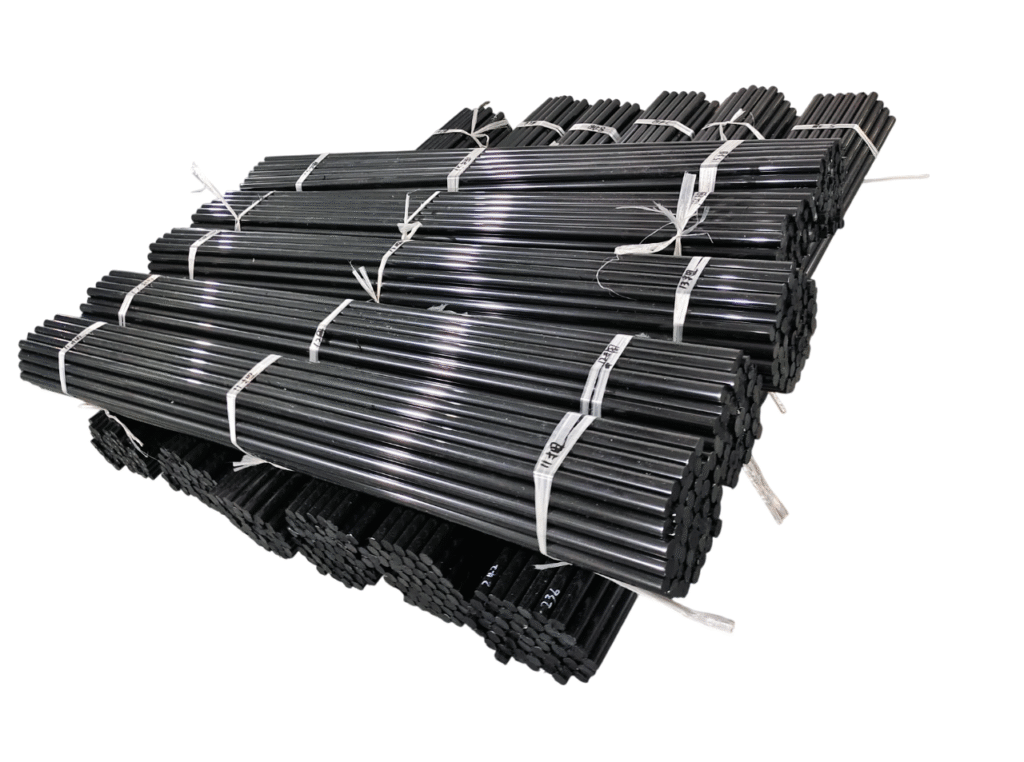
Where PBI Is Specified
· Semiconductor wafer process chambers — hot, plasma-exposed, contamination-critical
· Glass and LCD handling — non-marking contact at high temperature
· Aerospace — insulators and structural parts near heat sources
· Compressor and seal positions where both temperature and wear are extreme
· Electrical insulation requiring performance at 250–300°C
· Vacuum applications — very low outgassing compared with most plastics
A note on specifying: PBI is often quoted alongside PI and PEEK as if interchangeable. The honest comparison is by the highest sustained temperature at which the part must still carry load. Below 250°C, PEEK usually wins on toughness, chemistry, and cost. Between 250 and 300°C, PI serves most positions. Above 300°C, or where compressive strength at temperature decides, PBI is effectively the only polymer option — which is why it survives despite its price.
The Weak Points
PBI is not a general substitute. Its chemical resistance is its weakest point: concentrated acids and strong alkalis attack it, and it absorbs more moisture than PEEK or PI, which changes dimensions slightly and requires conditioning before precision machining. It is also brittle relative to PEEK — sharp corners and thread roots need radiused design. And it is expensive and available only in limited shapes and sizes. Specifying PBI for a part that PEEK would serve wastes money; specifying PEEK for a part that needs PBI properties fails in service. The decision usually turns on one question: does the part need real strength above 250°C?
Machining and Design Notes
· Machine dry with sharp carbide tooling; PBI cuts cleanly but chips are abrasive
· Condition material before final machining for dimensional stability
· Use generous radii — the material is brittle at corners
· Anneal after rough machining for critical flatness and bore roundness
· Verify chemical exposure against the grade datasheet before use in wet processes
Related reading: Polyimide (PI) Sheet Properties, PEEK Grades Explained, and Plastics for Semiconductor Wet Processing.

FAQ
Q1: What is the maximum temperature for PBI?
Around 310°C continuous, with much higher short excursions, and mechanical properties that remain strong across that range.
Q2: Is PBI better than PEEK?
At extreme temperature, yes. PBI retains stiffness above 300°C where PEEK has softened. Below 250°C, PEEK offers better chemical resistance, toughness, and cost.
Q3: What are PBI weaknesses?
Concentrated acids and alkalis attack it, it absorbs more moisture than PEEK, it is comparatively brittle, and it is the most expensive engineering plastic.
Q4: Why is PBI used in semiconductor equipment?
It withstands hot, plasma-exposed chamber conditions with low outgassing and dimensional stability.
Q5: How should PBI be machined?
With sharp carbide tooling, generous radii, conditioning before final cuts, and annealing for critical tolerances.
Operating above 250°C? Contact NAGOMER for PBI and PI stock shapes and machined components.
────────────────────────────────────────
NAGOMER — Professional Engineering Plastics Solutions
www.noegem.com | info@noegem.com