
News Centre
News Type
Send your inquiry

Antistatic and Conductive Plastics: ESD-Safe Material Selection
Surface Resistivity Classes
Class | Surface resistivity | Behaviour | Typical use |
Insulative | > 10^12 ohm/sq | Holds charge | General parts, no ESD control |
Antistatic | 10^9 – 10^12 | Slow bleed, seconds | Packaging, light handling |
Dissipative | 10^6 – 10^9 | Controlled bleed, milliseconds | ESD-protected assembly areas |
Conductive | < 10^6 | Rapid discharge, near metal | Containers, test fixtures, grounding |
Two Ways to Make Plastics Conductive
The first is migratory antistatic additives, which bloom to the surface and attract atmospheric moisture to form a conductive film. They are cheap, work well in dry-cleanroom packaging, and fail in two ways: the effect depends on humidity, and the additive is gradually washed or rubbed away. The second is permanent conductive fillers — carbon black, carbon fibre, carbon nanotubes, or intrinsically conductive polymers — dispersed through the compound. Filled grades cost more, darken the colour, and reduce toughness, but their performance does not migrate, does not depend on humidity, and survives cleaning. For production fixtures and cleanroom tooling, filled grades are almost always the right answer.
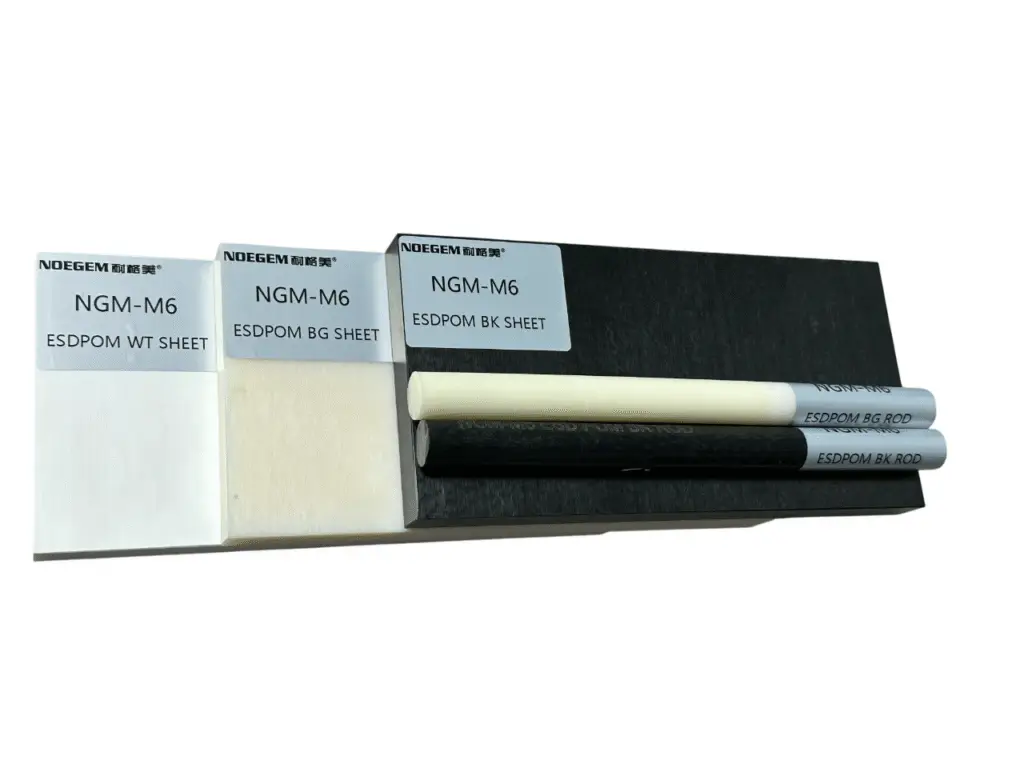
Material Options
· Conductive POM and PET-P — fixtures, trays, and handling components
· Conductive PEEK — high-temperature and cleanroom-critical applications
· Conductive PPS and PEI — structural parts needing ESD plus heat resistance
· Conductive UHMW-PE — conveyor rails and chute liners where wear is the primary duty
· Conductive PVC and PP — bench tops, workstation surfaces, and packaging
· Dissipative acetal and polycarbonate — jigs where transparency or machinability matters
Design and Handling Considerations
· Specify the class by resistivity range, not by colour — black is not a specification
· Carbon-fibre fillers can cause galvanic corrosion against aluminium and bare steel
· Filled grades are more abrasive — expect shorter tool life when machining
· Conductive parts must be grounded to function; an ungrounded dissipative tray does nothing
· Carbon black grades are opaque; transparent ESD plastics require special conductive systems
· Verify with a surface resistivity meter after machining, not only on the incoming stock
Where ESD Materials Are Used
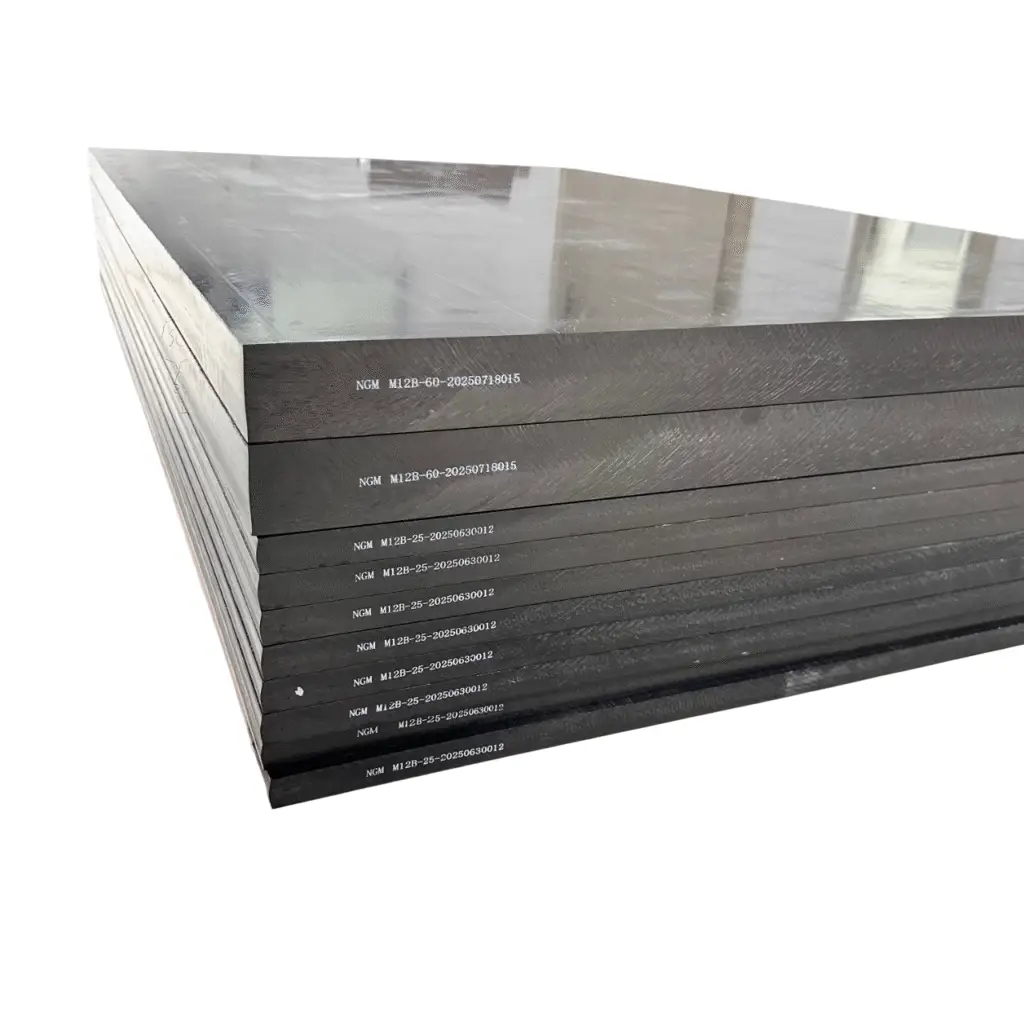
Electronics assembly, semiconductor front-end and back-end, PCB handling, medical device production, paint and solvent areas requiring static control, explosive atmospheres, and any area where a static discharge could ignite a flammable vapour. NAGOMER supplies ESD-safe sheet and rod in dissipative and conductive grades, machined into trays, fixtures, guides, and enclosures with resistivity certificates on request.
Related reading: Plastics for Semiconductor Test and Burn-in Sockets, Engineering Plastics Master Comparison, and POM-C vs POM-H.
FAQ
Q1: What is the difference between antistatic and conductive plastic?
Antistatic materials have surface resistivity between 10^9 and 10^12 ohm/sq and bleed charge slowly; conductive materials are below 10^6 and discharge almost as fast as metal.
Q2: Do antistatic additives wear out?
Migratory additives can be depleted by washing, abrasion, or prolonged storage, and their performance depends on humidity. Permanently filled grades do not have this limitation.
Q3: Is black plastic always ESD-safe?
No. Colour comes from pigment, not from conductivity. Only a measured resistivity value confirms the grade.
Q4: Can ESD plastics be machined normally?
Yes, but conductive fillers are abrasive, so carbide tooling and adjusted feeds extend tool life. Resistivity should be rechecked after machining.
Q5: Which ESD grade works at high temperature?
Conductive PEEK and PPS retain their electrical performance to 200°C and above, where conductive POM or PET-P would not survive.
Specifying an ESD-safe component? Tell NAGOMER the resistivity class and duty, and we will match the grade.
────────────────────────────────────────
NAGOMER — Professional Engineering Plastics Solutions
www.nagomer.com | info@nagomer.com