
News Centre
News Type
Send your inquiry

ECTFE (Halar) & ETFE: Chemical-Resistant Fluoropolymers Explained
Property Comparison
Property | ECTFE (Halar) | ETFE | PVDF (reference) |
Melting point (°C) | ~240 | 260–270 | 165–170 |
Continuous service (°C) | ~150 | 150–170 | 150 |
Chemical resistance | Excellent, broad | Very good | Good (weak in alkali) |
Abrasion resistance | Excellent | Good | Moderate |
UV / weathering | Very good | Outstanding | Excellent |
Permeation resistance | Excellent | Very good | Good |
Weldability | Yes | Yes | Yes |
The table explains why neither material is a general-purpose substitute. ECTFE and ETFE sit above PVDF on chemical range and durability but below PFA and PTFE on temperature and inertness, and they cost more than PVDF. Their justification is always a specific combination: ECTFE where chemistry and abrasion occur together, ETFE where sunlight is the dominant ageing mechanism.
Where ECTFE Excels
· Chemical plant linings and coatings where abrasion accompanies chemical attack
· Semiconductor high-purity fluid handling with better wear than PVDF
· Pump and valve components in aggressive slurries
· Tank linings for oxidising acids at moderate temperature
· Wire and cable jacketing in chemically exposed areas
Where ETFE Excels
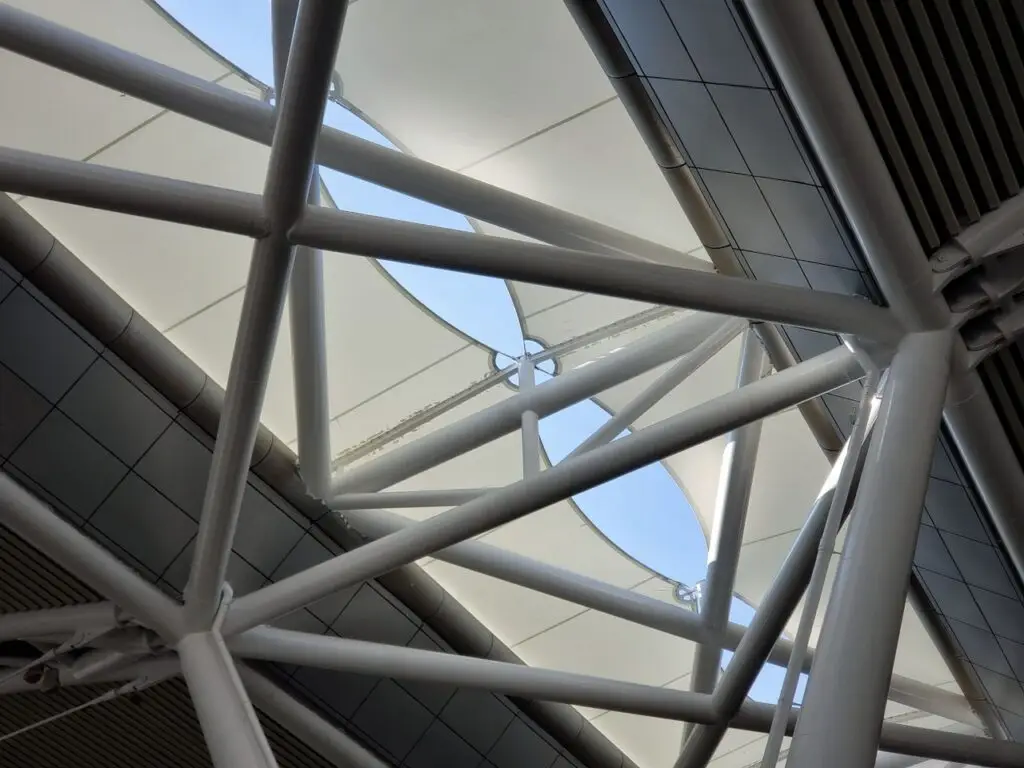
· Architectural membranes and roof structures — decades of UV exposure with minimal loss
· Cable insulation for harsh and outdoor environments
· Moulded components needing transparency and chemical resistance
· Coatings and linings where long-term weathering dominates
· Protective films and release surfaces
ETFE foil weighs roughly one percent of equivalent glazing, which changes the structural calculation for a roof entirely: less steel, fewer columns, and spans that glass cannot achieve. The material also self-cleans reasonably well because its surface energy is low, so rain sheds dirt rather than holding it. Those two properties, weight and surface behaviour, are what turned ETFE from a chemical-industry material into an architectural one.
Why Choose These Over PTFE or PVDF
Against PTFE, the advantage is processability: both ECTFE and ETFE can be extruded, injection moulded, and welded, which allows linings and complex shapes that PTFE cannot deliver. Against PVDF, the advantage is chemistry and wear. PVDF is limited by strong alkalis and amines and has moderate abrasion resistance; ECTFE handles both better, at a higher price. ETFE trades some chemical range for the best weathering of any fluoropolymer, which is why it dominates architectural membranes where appearance matters over decades. In practice, selection comes down to which single property is the real constraint — chemistry, wear, or sunlight — because all three materials are chemically respectable.
Fabrication Notes
· Both weld well — sheet lining and fabricated vessels are practical
· Thermal control during processing is critical; decomposition products are hazardous
· Abrasion-resistant ECTFE grades suit slurry and particulate duty
· Confirm UV grade where exposed to sunlight for architectural applications
· Specify permeation data for thin linings in aggressive service
Related reading: PVDF Sheet Guide, PFA & FEP Fluoropolymers, and Chemical Processing Plants Material Guide.
FAQ
Q1: Is Halar the same as ECTFE?
Yes — Halar is a trade name for ECTFE (ethylene chlorotrifluoroethylene), a melt-processable fluoropolymer with excellent chemical and abrasion resistance.
Q2: Which is better for architectural membranes, ETFE or PTFE?
ETFE is transparent, extremely UV stable, and far lighter than glass or PTFE-coated fabric, which is why it is used for stadium and atrium roofs.
Q3: Can ECTFE replace PVDF?
Often yes, especially where strong alkalis or abrasion are involved. ECTFE costs more but performs better in those specific conditions.
Q4: Do these materials need special processing?
Yes — high melt temperatures and careful thermal control are required, and ventilation is essential because decomposition products are hazardous.
Q5: Which fluoropolymer resists weathering best?
ETFE leads, followed by PVDF and ECTFE. All three outperform most engineering plastics outdoors by a wide margin.
Selecting fluoropolymers for harsh service? Contact NAGOMER for ECTFE, ETFE, PVDF, and PTFE material guidance and machined parts.
────────────────────────────────────────
NAGOMER — Professional Engineering Plastics Solutions
www.nagomer.com | info@nagomer.com