
News Centre
News Type
Send your inquiry

Mining & Bulk Material Handling: Wear-Resistant Engineering Plastics
Material Selection for Wear Duty
Application | Material | Why It Works |
Chute & hopper liners | UHMW-PE | Low friction prevents build-up; high abrasion resistance |
Truck tray & bed liners | UHMW-PE | Material slides out instead of sticking and freezing |
Wear pads & impact bars | UHMW-PE, PA cast | Absorb impact without cracking |
Screen & trommel components | PEEK, PU | Wear resistance with structural strength |
Bushings on conveyors | PEEK + PTFE + graphite | Dry running, no grease contamination |
Chain & belt guides | UHMW-PE, PA | Low friction at speed, quiet operation |
The Sticking Problem Nobody Prices
Abrasion is the obvious cost, but material build-up is often more expensive. Wet coal, iron ore fines, and clay-rich ores stick to steel chutes in cold weather, blocking transfer points and forcing manual clearing — sometimes in hazardous positions. UHMW-PE’s low coefficient of friction means material slides rather than accumulates, so the chute keeps flowing. Operators consistently report that this single benefit justifies the liner cost before any wear saving is counted, because it eliminates the labour and safety exposure of clearing blockages.
Design and Installation Notes
· Fix liners mechanically — UHMW-PE cannot be bonded reliably
· Counterbore fasteners and recess heads so they do not wear or obstruct flow
· Allow for thermal expansion of roughly ten times steel over the same temperature range
· Leave a small gap between liner sections to accommodate movement
· Use thicker sheets where impact dominates, thinner where sliding wear dominates
· Vent or perforate liners where moisture could be trapped behind them
Cost Comparison Against Steel and Rubber
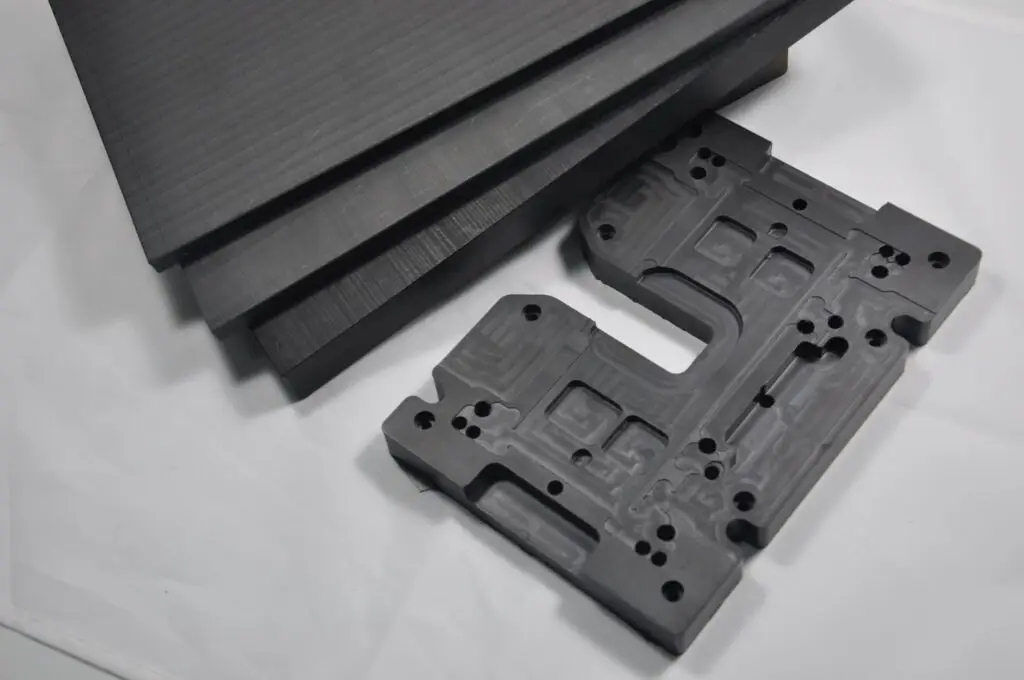
Steel liners are cheaper per square metre but corrode, rust on idle, and generate noise. Rubber handles impact well but tears on sharp ore and degrades faster at elevated temperature. UHMW-PE sits between them: more abrasion resistant than steel in sliding duty, better than rubber against sharp material, and immune to the corrosion that shortens both. The right answer is usually a combination — rubber for high-impact drop zones, UHMW-PE for sliding surfaces downstream — and the replacement interval, not the purchase price, is what determines which is truly cheaper. NAGOMER supplies UHMW-PE sheet, PEEK wear parts, and machined components for mineral processing operators and equipment builders.
Finally, consider noise and dust alongside wear. UHMW-PE liners run noticeably quieter than steel, which matters at transfer points close to workplaces, and their non-stick surface reduces the dust generation that accompanies material build-up and manual clearing. Neither effect is easy to price, but both are immediately obvious on site — and both appear in the operator feedback long before they appear in a maintenance budget.
Related reading: UHMW-PE Sheet Guide, Bearings & Bushings Material Selection, and Cast Nylon & PA12 Guide.
FAQ
Q1: What is the best liner material for wet, sticky ore?
UHMW-PE. Its low friction prevents material from adhering, which is where steel and rubber liners fail first.
Q2: How long do UHMW-PE chute liners last?
In sliding abrasion service, typically several times longer than mild steel, with the advantage that they do not corrode during shutdown periods.
Q3: Can UHMW-PE handle high-impact drop zones?
It absorbs impact well, but for very large lump sizes a rubber or combined liner is often better at the impact point, with UHMW-PE downstream.
Q4: Is UHMW-PE suitable for cold climates?
Yes — it retains toughness down to cryogenic temperatures, which is a significant advantage over steel and many elastomers in freezing conditions.
Q5: How should liners be fastened?
With countersunk mechanical fasteners and large washers. Adhesives do not bond reliably to UHMW-PE, so mechanical fixing is the only dependable method.
Upgrading chutes, hoppers, or conveyors? Contact NAGOMER for UHMW-PE sheet, PEEK wear parts, and machined components for mineral processing.
────────────────────────────────────────
NAGOMER — Professional Engineering Plastics Solutions
www.nagomer.com | info@nagomer.com