
News Centre
News Type
Send your inquiry

PA6 vs PA66 vs PA12: Choosing the Right Nylon Grade
The Three Grades at a Glance
Property | PA6 | PA66 | PA12 |
Melting point | ~220°C | ~260°C | ~178°C |
Continuous service | ~90–100°C | ~100–120°C | ~80°C |
Moisture absorption (sat.) | ~9% | ~8% | ~1.5% |
Dry impact strength | Good | Moderate | Excellent |
Dimensional stability | Moderate | Moderate | Excellent |
Relative cost | Low | Low | Higher |
Water Absorption Drives Everything
All nylons absorb moisture, and absorbed water acts as a plasticiser: the part swells, toughens, and loses stiffness and strength. The scale of the effect separates the grades. PA6 and PA66 can take up several percent of their own weight, which translates into dimensional change of 0.5 to 2% depending on section thickness — enough to close a clearance or crack a tight bore. PA12 absorbs roughly a fifth as much, so a PA12 bush holds its fit in a humid plant where a PA66 bush would seize. The practical rule is that moisture-sensitive fits, precision bores, and thin-wall parts favour PA12, while dry, lightly loaded structures can exploit the cheaper and stiffer PA6 and PA66.
Heat and Mechanical Performance
PA66 has the highest melting point and the best hot stiffness of the three, which is why it dominates under-bonnet brackets, cable ties, and parts that see 100°C continuously. PA6 is slightly softer and tougher than PA66 in the dry state, machines more easily, and is more forgiving of impact — a common choice for wear pads, guide rollers, and general machined components. PA12 is the softest and least strong of the three, yet its impact strength at low temperature is the best, and it holds elongation well below freezing. Where a part must survive hammer blows at −40°C, low-moisture PA12 usually wins over any dry-blend alternative.
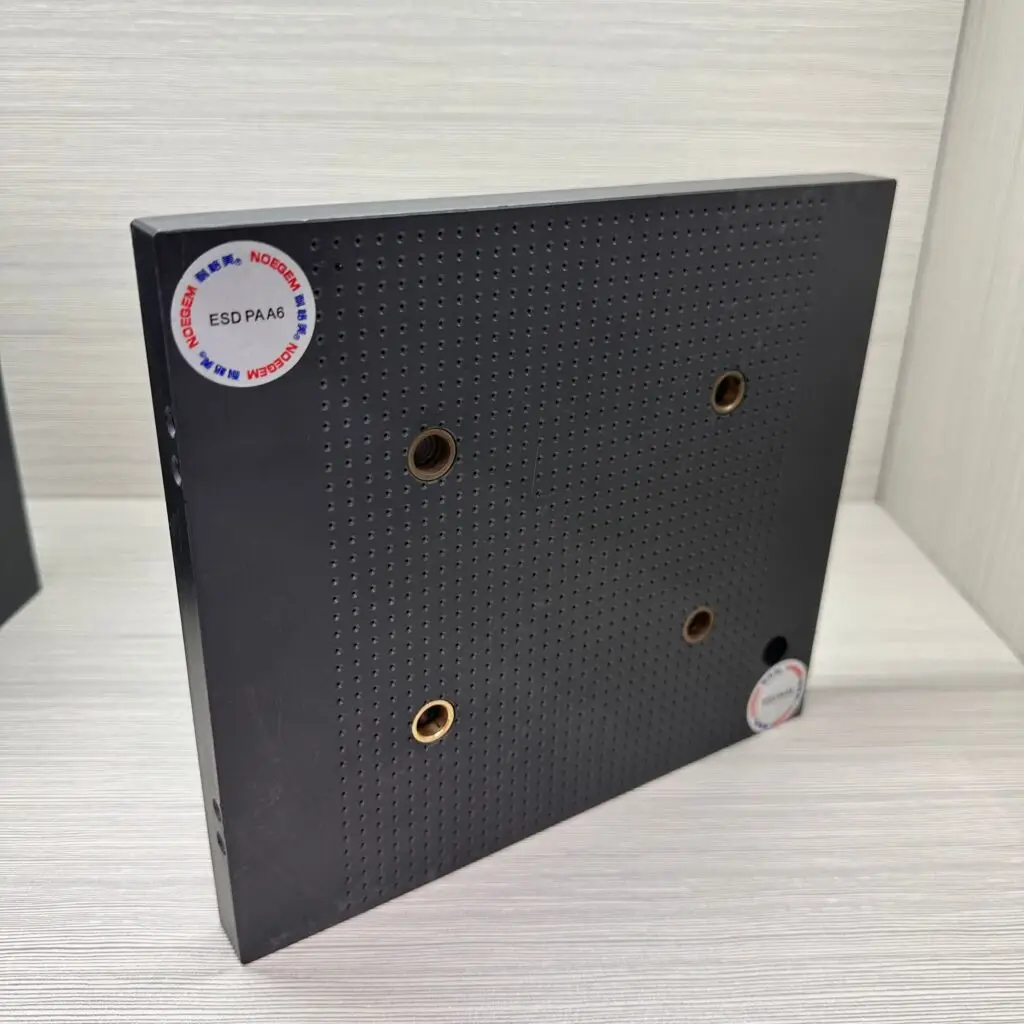
Machining, Annealing and Stress
· Extruded and cast nylon stock carries internal stress — rough machine, then anneal before finishing
· Typical anneal: 2 hours at 150–160°C for PA6 and PA66, lower for PA12 to avoid distortion
· Use sharp, high-rake tooling with generous chip clearance; nylon cuts cleanly but melts if rubbed
· Cool with air or flood coolant — heat build-up produces gummy chips and poor surface finish
· Allow for moisture conditioning after machining so the finished part reaches equilibrium before inspection
Applications and Selection Rules
· PA66 — hot brackets, housings, clips, and structural parts up to 120°C
· PA6 — wear pads, rollers, guides, and general machined parts in dry service
· PA12 — precision bushes, pneumatic fittings, low-temperature and humid-duty components
· PA12 or PA66 with glass fibre — where stiffness and creep resistance outweigh impact needs
· Cast PA6 (MC nylon) — very large sections such as sheaves and gears above 100 mm diameter
NAGOMER supplies nylon sheet, rod, and tube in PA6, PA66, and PA12, including cast and glass-filled grades, machined to drawing with annealing on request.
Related reading: Cast Nylon PA12 Sheet Guide, POM-C vs POM-H Copolymer vs Homopolymer, and Machining Engineering Plastics.
FAQ
Q1: Which nylon absorbs the least water?
PA12 absorbs roughly 1.5% at saturation, compared with about 8–9% for PA6 and PA66, which makes PA12 far more dimensionally stable in humid service.
Often, where service temperature stays below about 90°C. PA66 remains the better choice for sustained heat above 100°C and for higher stiffness at temperature.
Q3: Why do machined nylon parts change size after a few weeks?
They are absorbing moisture from the air, which swells the material. Conditioning before final machining or allowing for the swell in the drawing resolves it.
Q4: Is nylon suitable for outdoor use?
Standard grades degrade under UV. Black UV-stabilised grades are available and are the correct choice for outdoor parts.
Q5: What is cast nylon and when is it used?
Cast (MC) nylon is polymerised in the mould, allowing thick sections and large diameters that extrusion cannot produce, with better wear performance in heavy-duty sheaves and gears.
Need help selecting between PA6, PA66, and PA12? Send NAGOMER your duty conditions and drawing.
────────────────────────────────────────
NAGOMER — Professional Engineering Plastics Solutions
www.nagomer.com | info@nagomer.com