
News Centre
News Type
Send your inquiry

PAI (Torlon) vs PEEK: Choosing for Extreme Wear and High Temperature
Property Comparison
Property | PAI (Torlon) | PEEK |
Glass transition (°C) | ~275 | 143 |
Continuous service temp (°C) | 250–260 | 250 |
Tensile strength (MPa) | 130–190 | 90–100 |
Flexural modulus (GPa) | 4.5–5.5 | 3.6–4.0 |
Compressive strength (MPa) | ~200 | ~120 |
Wear / PV capability | Excellent | Very good |
Hot water & steam | Poor — hydrolyses | Excellent |
Moisture uptake | 1.5–2.5% | 0.3–0.5% |
Relative cost | High | High |
PAI is roughly twice as strong and stiff as PEEK, and it keeps that strength to a higher temperature. Its weakness is moisture and hydrolysis: hot water and steam destroy PAI parts, whereas PEEK is one of the most hydrolytically stable polymers available.
Where PAI Earns Its Cost
· High-load, high-PV bearings and thrust washers running dry
· Seal rings, compressor components, and valve seats at 250°C+
· Semiconductor test sockets and burn-in fixtures needing stiffness and thermal stability
· Precision gears under substantial load where PEEK would wear too fast
· High-strength structural parts that must remain electrically insulating

Where PEEK Remains the Right Choice
· Any service involving hot water, steam, or repeated sterilisation
· Chemical exposure including aggressive acids and solvents
· Parts machined from stock where low moisture uptake matters for tolerance
· Medical implants and devices requiring established biocompatibility data
· Applications needing welded or moulded geometry
Processing and Practical Notes
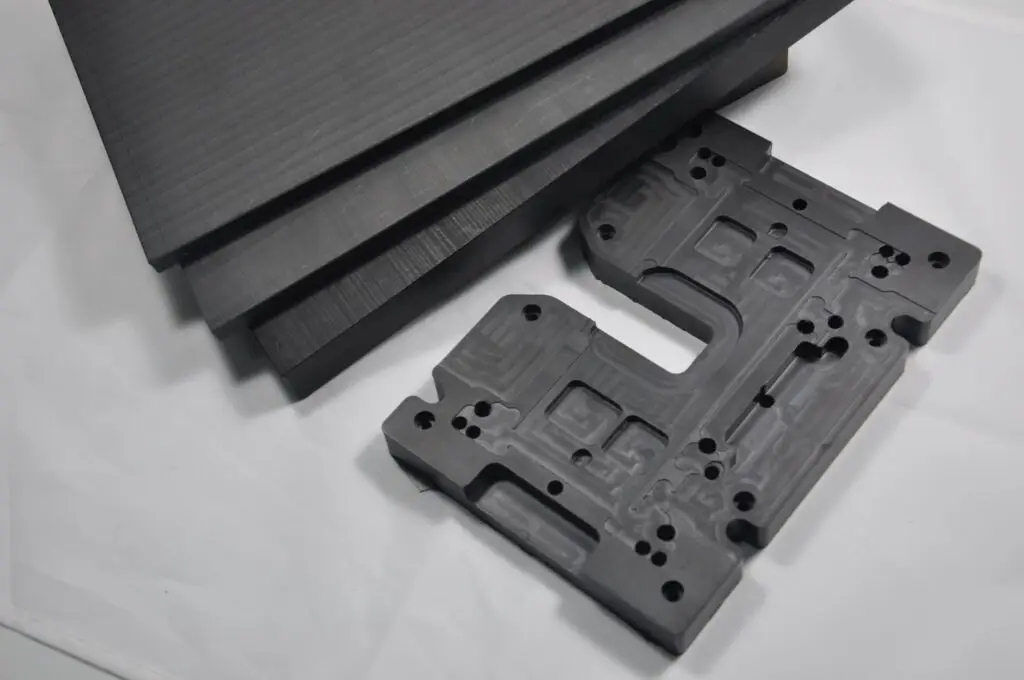
PAI is usually compression moulded and then post-cured, and it machines more abrasively than PEEK — expect faster tool wear and plan for carbide or diamond tooling. Unfilled grades are notch sensitive, so generous radii are essential. Because of its moisture uptake, PAI parts should be conditioned before final machining where tolerance is critical, and stored away from humid air. Note that PAI (polyamide-imide) is a different polymer from PI (polyimide), although both serve high-temperature duties; PAI is tougher and easier to machine, PI goes higher in temperature. NAGOMER machines PAI and PEEK components to drawing with full material certification.
If PAI is being considered simply because a PEEK part wore out, it is worth checking whether the failure was actually temperature related. PEEK composites filled with carbon fibre, graphite, and PTFE deliver wear performance close to PAI in most dry-running duties at lower cost, and they tolerate the moisture that PAI cannot. Reserve PAI for the cases where its combination of strength, stiffness, and high-temperature wear resistance is genuinely necessary — then the cost difference is easy to justify.
Related reading: Polyimide (PI) Plastic Guide, PEEK Filled Grades Guide, and Bearings & Bushings Material Selection.
FAQ
Q1: Is PAI stronger than PEEK?
Yes — tensile strength of 130–190 MPa versus 90–100 MPa for PEEK, with roughly 40% higher stiffness, and it retains that advantage at elevated temperature.
Q2: Can PAI be used in steam or hot water?
No. PAI hydrolyses in hot water and steam and will degrade quickly. Use PEEK, PPS, or sulfone polymers for hydrolytic service.
Q3: What is the difference between PAI and PI?
Both are high-temperature polymers. PAI (polyamide-imide) is tougher, more wear resistant, and easier to machine; PI (polyimide) has a higher glass transition and better radiation resistance but is more brittle.
Q4: Why does PAI need post-curing?
Compression-moulded PAI is only partially imidised after forming. Post-curing completes the reaction and develops full mechanical and thermal properties.
Q5: Which is better for dry-running bearings?
PAI, particularly graphite- or PTFE-filled grades, offers the highest PV capability and wear resistance of any common engineering plastic. PEEK+PTFE+graphite is the practical alternative where moisture or chemicals are present.
Pushing the limits of PEEK? Contact NAGOMER for PAI and PEEK stock shapes and machined components for extreme duty.
────────────────────────────────────────
NAGOMER — Professional Engineering Plastics Solutions
www.nagomer.com | info@nagomer.com