
News Centre
News Type
Send your inquiry
Plastics for CO2 & Refrigeration Systems: Seals, Valves and Components
Why Refrigerants Are Hard on Materials
· Refrigerants permeate polymers and can blister seals during rapid depressurisation
· Lubricants circulate with the refrigerant and contact every seal
· CO2 systems run at 80–130 bar, demanding extrusion-resistant materials
· Low-side temperatures down to −40°C embrittle many polymers
· Compressor discharge temperatures above 100°C stress valve components
Material Guide by Component
Component | Material | Key Requirement |
Valve seats & discs | PEEK, filled PTFE | Extrusion resistance at pressure |
Compressor valve plates | PEEK, PEEK CF30 | Fatigue at 100–150°C |
Shaft seals & backup rings | PTFE composites, PEEK | Low friction, chemical inertness |
Piston rings & guide rings | Filled PTFE, PEEK | Dry running with refrigerant |
Insulation blocks & mounts | PEEK, PPS, PA | Thermal isolation, low conductivity |
Sensor & control housings | PPS, PA66, PBT | Temperature plus chemical resistance |
CO2 Systems Change the Requirements
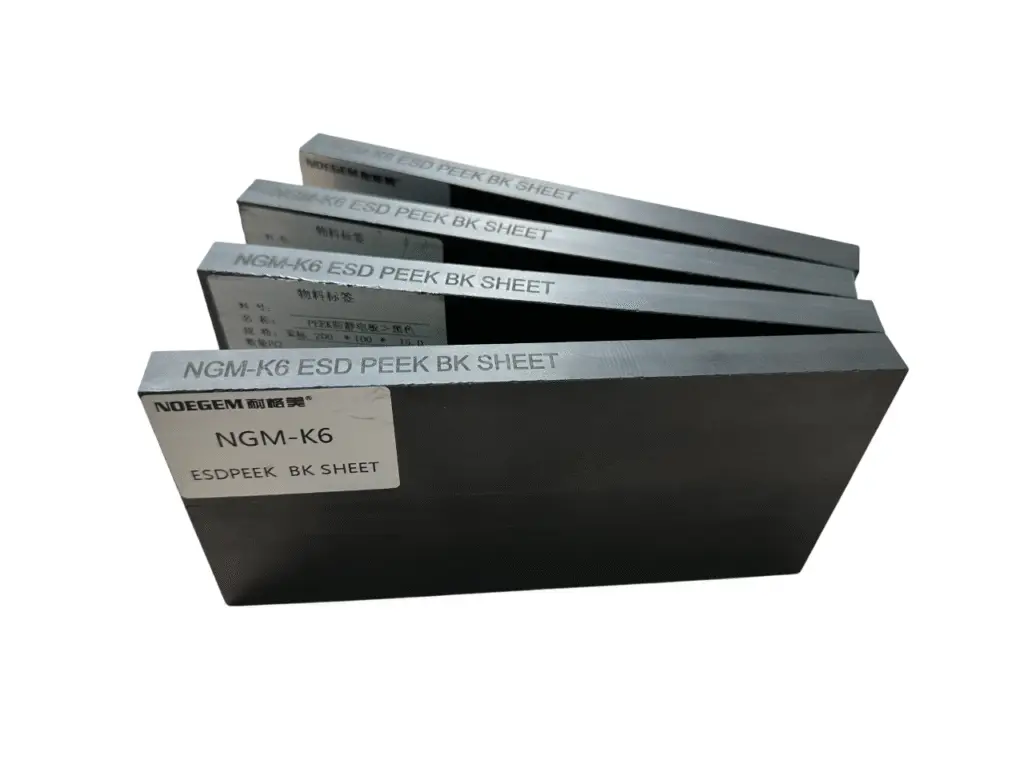
Carbon dioxide as a refrigerant operates at far higher pressures than the fluorinated gases it replaces: typical transcritical systems run at 80–130 bar, well beyond the range of conventional refrigeration components. That places enormous demands on seals and seats, which must resist extrusion into the clearance gap under sustained load. PEEK and filled PTFE are the standard answers, often combined with carefully designed backup rings. Low-side operation also reaches −40°C, where ductility falls and leak paths appear if the material was selected only on room-temperature data.
Lubricant Chemistry and Compatibility
Refrigeration lubricants — mineral oils, POE, PAG, and PVE — circulate continuously and contact every polymer component. Compatibility must be checked against the lubricant actually used, not the refrigerant alone, because swelling and property loss usually come from the oil. PEEK and PTFE handle essentially all common lubricants; polyamide and POM are more sensitive. In systems with variable-speed compressors, the higher oil circulation also raises wear at sliding interfaces, which favours filled grades with solid lubricants built in.
Testing and Specification
· Verify pressure rating at maximum operating temperature, not ambient
· Test seal performance through full thermal cycles including pull-down
· Check compatibility with both refrigerant and lubricant together
· Allow for polymer swelling in seal groove design
· Confirm low-temperature impact performance where the low side reaches −40°C
A note on leakage: refrigeration circuits are sealed for a decade, and a seal that permeates slowly is not obviously failing until charge is lost. Material selection should therefore consider permeation rate, not only mechanical sealing. PEEK and filled PTFE are relatively good in this respect, while thin-section unfilled polymers permit measurable loss over time — a factor that matters far more in a hermetic CO2 system than in an open hydraulic circuit.
Related reading: Plastics for Oil-Free Compressors, PEEK Filled Grades Guide, and Engineering Plastics for Pumps, Valves & Seals.
FAQ
Q1: Which plastics suit CO2 refrigeration?
PEEK, filled PTFE, and PPS handle the high pressure and wide temperature range. Seats and seals are usually PEEK or filled PTFE with backup rings.
Q2: Can standard plastics handle refrigerant?
Many polymers are permeated by refrigerants and swelled by lubricants. Compatibility must be verified with the specific refrigerant-lubricant pair, not the refrigerant alone.
Q3: What temperatures do refrigeration components see?
From roughly −40°C on the low side to over 120°C at compressor discharge, which is why only high-performance polymers serve the hot positions.
Q4: Why do seals fail in refrigeration systems?
Commonly extrusion under pressure, swelling from lubricant contact, or blistering during rapid depressurisation. Material and groove design must address all three.
Q5: Is PEEK used in compressor valves?
Yes — PEEK valve plates are standard in refrigeration and air compressors thanks to fatigue endurance at temperature and low mass.
Designing refrigeration components? Contact NAGOMER for PEEK and filled PTFE parts for high-pressure and low-temperature duty.
────────────────────────────────────────
NAGOMER — Professional Engineering Plastics Solutions
www.nagomer.com | info@nagomer.com