
News Centre
News Type
Send your inquiry

Plastics for Hydrogen Energy: Valves, Seals & Storage Components
What Hydrogen Does to Materials
· Permeation — hydrogen diffuses through materials; the rate matters for containment and safety
· High pressure — 700 bar storage demands exceptional extrusion and compression resistance
· Cryogenic duty — liquid hydrogen at −253°C embrittles most polymers
· Blistering — rapid decompression can form internal gas blisters in elastomers and some plastics
· Hydrogen embrittlement of metals — the reason polymer internals are often preferred
Component Guide for the Hydrogen Chain
Component | Recommended Materials | Key Demand |
Electrolyser valve seats | PEEK, PEEK CF30 | Wear, chemical exposure, 80–90°C KOH |
Storage valve seats & seals | PEEK, filled PTFE | 700 bar extrusion resistance |
Compressor rings & packing | Filled PTFE, PEEK composites | Dry gas wear, high cycle |
Fuel cell stack components | PEEK, PPS, PPSU | Humidity, temperature, electrical |
High-pressure tubing | PA12, PVDF-lined steel | Permeation control, pressure |
Dispensing hoses & fittings | PA12, PEEK | Cold flow, abrasion, fast cycling |
Sealing at 700 Bar
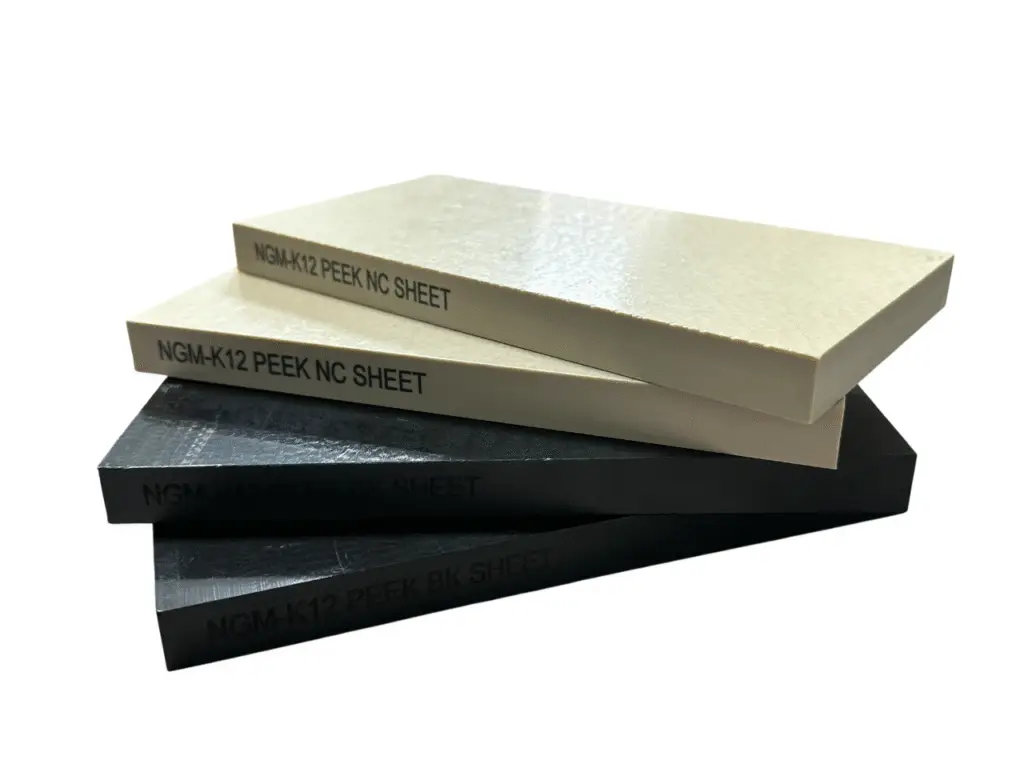
At 700 bar, seal design is unforgiving. Elastomers face rapid gas decompression, where dissolved hydrogen forms internal blisters during pressure release and tears the seal apart — a failure mode distinct from ordinary compression set. Polymer solutions centre on PEEK and filled PTFE seats with carefully designed backup rings, combined with hydrogen-rated elastomers where flexibility is needed. Thermal cycling between ambient and cryogenic precooling during fast-fill adds a second dimension, so seal materials are validated across the full temperature envelope, not just at pressure.
Where PEEK Dominates the Chain
Across electrolysis, compression, storage, and dispensing, PEEK appears at nearly every critical interface. It resists extrusion at 700 bar, keeps its properties in KOH electrolyte at 80–90°C, survives rapid decompression better than most alternatives, and remains dimensionally stable through thermal cycles. Its compressive strength and wear resistance suit valve internals that cycle millions of times. The economics follow the usual pattern for premium polymers: expensive per part, cheap per year of reliable service in an application where a failure is anything but routine.
Specification Notes for Hydrogen Programmes
· Validate for rapid decompression, not just static pressure — the failure modes differ
· Test seals across the full temperature envelope including precooling excursions
· Measure permeation for containment components rather than assuming it away
· Confirm chemical compatibility with the electrolyte or coolant in the specific system
· Request material traceability — hydrogen safety cases demand documented chains
Related reading: PEEK Filled Grades Guide, Engineering Plastics for Pumps, Valves & Seals, and Plastics at Cryogenic Temperatures.
FAQ
Q1: Does hydrogen damage plastics the way it embrittles metals?
Not through the same mechanism. Polymers do not hydrogen-embrittle, but hydrogen permeates them and can cause blistering during rapid decompression, particularly in elastomers.
Q2: Why is PEEK so common in hydrogen valves?
It combines extrusion resistance at 700 bar, wear resistance over millions of cycles, chemical stability in electrolyte, and dimensional stability across thermal cycles.
Q3: Can PA12 tubing carry high-pressure hydrogen?
PA12 is used for hydrogen lines within pressure ratings set by standards and testing. For the highest pressures, polymer-lined steel or all-metal solutions are used.
Q4: What is rapid gas decompression?
During fast pressure release, hydrogen dissolved in a material forms internal blisters that tear it apart. Seal materials must be validated for this specifically.
Q5: Are plastics suitable for liquid hydrogen at −253°C?
Only a few — PTFE, PCTFE, and PEEK retain function at cryogenic temperatures with reduced ductility. Standard elastomers and most thermoplastics do not.
Developing hydrogen equipment? Contact NAGOMER for PEEK, PTFE, and PPS components engineered for high-pressure hydrogen service.
────────────────────────────────────────
NAGOMER — Professional Engineering Plastics Solutions
www.nagomer.com | info@nagomer.com