
News Centre
News Type
Send your inquiry

Plastics for Laboratory & Analytical Instruments
The Low-Extractables Imperative
Every surface in an analytical flow path is a potential source of contamination. Metal valves and fittings leach trace ions, corrode in salt buffers, and adsorb proteins and chelating agents. PEEK flow paths solve all three: chemically inert to nearly all mobile phases, metal-free by construction, and smooth enough to avoid dead zones. That is why modern HPLC systems are PEEK-lined or PEEK-bodied from solvent bottle to detector, and why instrument makers specify polymer flow paths wherever pressure and temperature allow.
Material Guide for Instrument Components
Component | Material | Why |
HPLC pump heads & check valves | PEEK, PEEK with ceramic/sapphire seats | Metal-free, pressure to ~60 MPa |
Valve rotors & stators | PEEK, filled PEEK | Wear, sealing, inertness |
Sample & needle seats | PEEK, PPS | Precision, no adsorption |
Column hardware (frits excepted) | PEEK, PFA-lined | Inert flow path |
Centrifuge rotors & bottles | PP, PA, PC | Balance of strength and cleanability |
Spectrometer & sensor housings | PEEK, PEI, PPS | Dimensional stability, low outgassing |

Pressure: Where Metal Still Wins
The historical limit of polymer flow paths was pressure. Early PEEK columns and fittings topped out far below the stainless hardware they replaced. Modern PEEK grades and smarter designs now serve systems at 600 bar and beyond — enough for mainstream HPLC and most UHPLC front-ends — but the very highest-pressure UHPLC systems still use metal columns with polymer-protected external surfaces. The practical rule: specify the pressure rating of the specific PEEK component rather than assuming, and match the fitting system exactly, because cross-brand HPLC fittings are the most common leak source in the laboratory.
Beyond Chromatography
· Mass spectrometry — PEEK and PEI ion-source components resist heat and solvent chemistry
· Centrifugation — PP and PA rotors for corrosive buffers, PC for transparency
· Sample storage — PP and PFA vials and containers for trace analysis
· Automation — POM and PET-P moving parts that need no lubricant near samples
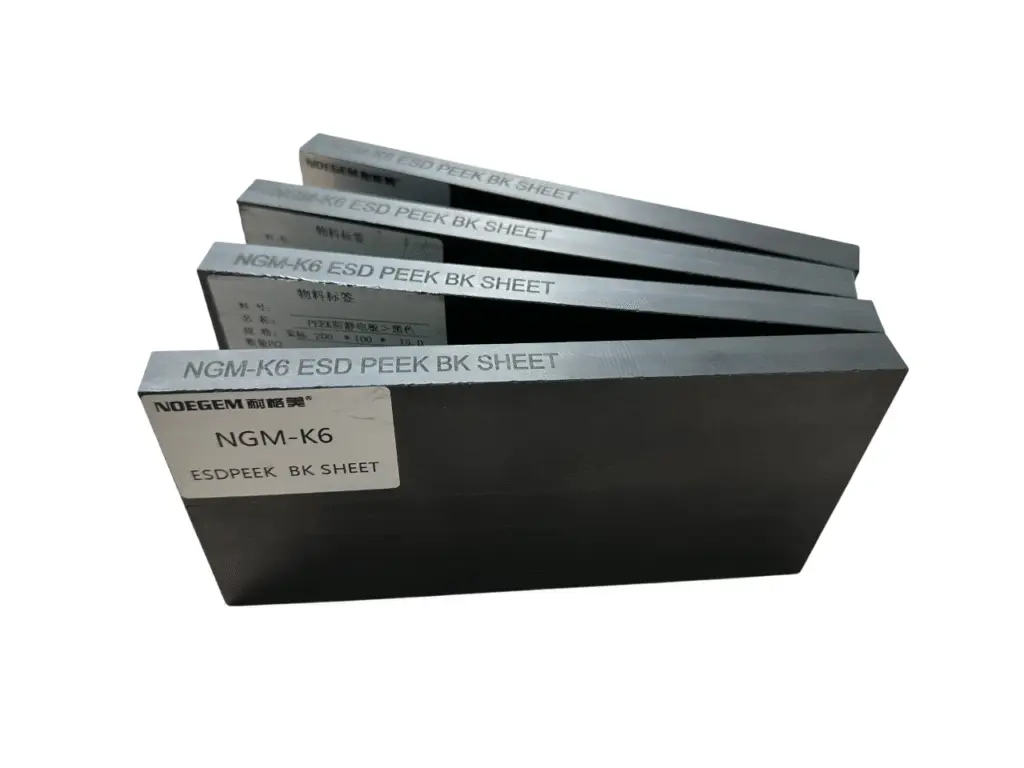
· Cleanroom robotics — ESD-capable PEEK for electronics-adjacent laboratory automation
Machining for Instrument Makers
Instrument development runs on small volumes and frequent design changes, which makes machined polymer components the natural route. Tolerances on valve seats and rotor faces are tight — measured in microns — and surface finish directly affects sealing and carry-over. NAGOMER machines PEEK, PEI, PPS, and POM components for analytical instrument OEMs, with the batch traceability that laboratory equipment validation requires.
Related reading: PEEK Plastic Sheet Properties, PEEK Chemical Resistance Chart, and Engineering Plastic Quality Control.
FAQ
Q1: Why is PEEK used in HPLC systems?
It is chemically inert to nearly all mobile phases, metal-free, smooth, and available in pressure-rated components — so the flow path adds no contamination and adsorbs nothing.
Q2: What pressure can PEEK flow paths handle?
Modern PEEK components and columns serve systems at 600 bar and beyond. Always check the rating of the specific fitting or column, as it varies by design.
Q3: Are plastic flow paths compatible with all solvents?
PEEK resists nearly all HPLC mobile phases, but concentrated nitric and sulphuric acids are exceptions. Check compatibility for the specific chemistry.
Q4: Can PEEK replace stainless in UHPLC?
For most front-end components yes; for the highest-pressure columns, metal remains standard, often with polymer-protected external surfaces.
Q5: Why do labs prefer polymer centrifuge rotors?
They resist corrosive buffers that pit aluminium, weigh less, and fail less catastrophically — though with lower speed ratings than metal rotors.
Building analytical instruments? Contact NAGOMER for metal-free PEEK flow-path components machined to drawing.
────────────────────────────────────────
NAGOMER — Professional Engineering Plastics Solutions
www.nagomer.com | info@nagomer.com