
News Centre
News Type
Send your inquiry

Plastics for Medical Imaging: MRI, CT & X-Ray Equipment
Requirements by Imaging Modality
Modality | Key Material Requirement | Preferred Materials |
MRI | Non-magnetic, no RF interference | PEEK, PEI, PPSU, PPS |
CT / X-ray | Radiolucent — transmit rays without artefacts | Carbon-fibre composites, PEEK |
PET | Low attenuation, low outgassing | PEEK, PEI, carbon composites |
Ultrasound | Acoustic properties, cleanability | PEI, PSU, POM |
All modalities | Disinfectant resistance, ISO 10993 biocompatibility | PEEK, PPSU, PEI |
The common thread is invisibility: the structure must not appear in the image. Metal creates streak artefacts in CT and distorts MRI fields entirely, so carbon-fibre composites and radiolucent polymers carry the structural load instead.
Positioning and Patient-Contact Components
· CT and PET couch tops — carbon-fibre sandwich panels for stiffness with transparency to rays
· Head coils and localisation frames — PEEK and PEI for dimensional stability and non-magnetic duty
· Positioning pads and fixation devices — mouldable, cleanable, biocompatible polymers
· Biopsy and interventional templates — PEEK, machined to patient-specific geometry
· Equipment housings and cable carriers — PPSU and PEI for disinfectant resistance

The MRI Constraint Changes Everything
MRI compatibility is not merely about avoiding iron. Any conductive material can interact with the RF field, heat up, or distort images, so even non-magnetic metals such as titanium are restricted near the bore. Engineering polymers are effectively invisible to the scanner, which is why PEEK and PEI are standard for fixtures and instruments that must operate inside the magnet. The second constraint is cleaning: imaging suites cycle strong disinfectants continuously, and materials that craze or discolour under them quickly become a hygiene problem. PPSU and PEI handle the chemistry; unfilled PC does not.
Machining and Documentation
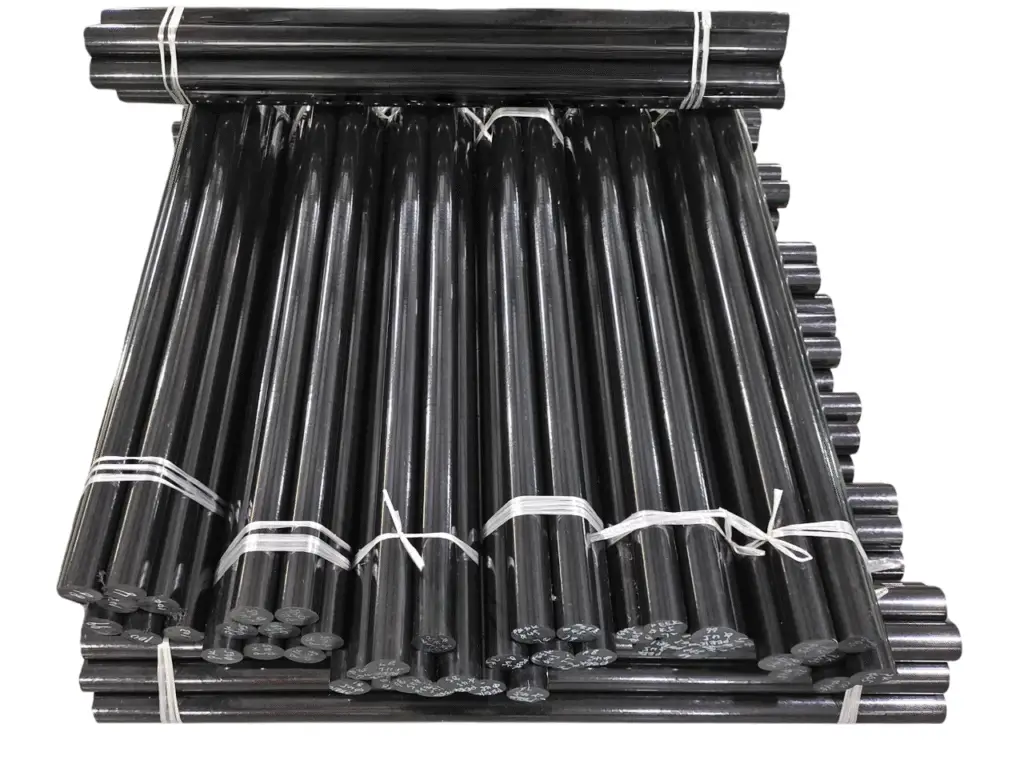
Imaging components are frequently patient-specific or low-volume, which makes machining from stock the natural route — no tooling, fast iteration, and full traceability. Biocompatibility documentation (ISO 10993 or USP Class VI) for the exact grade, plus batch traceability, completes the package that device manufacturers need for their regulatory files. NAGOMER machines imaging-suite components from certified PEEK, PEI, and PPSU stock with the documentation medical programmes require.
Patient-specific components deserve a note of their own. Biopsy templates and positioning guides are increasingly machined from PEEK to match imaging data, and the same properties that make PEEK invisible to the scanner — radiolucency, dimensional stability, sterilisability — make it the natural choice for interventional hardware. Because these parts are low volume and highly individual, machining from certified stock is the only practical production route, and it doubles as the fastest way to iterate a design between clinical feedback and the next version.
Related reading: PEEK in Medical Devices, Plastics for Medical Sterilisation, and PPSU & PSU Sulfone Polymers.
FAQ
Q1: Why is PEEK used in MRI equipment?
PEEK is non-magnetic, transparent to imaging, dimensionally stable, and resistant to hospital disinfectants — it can operate inside the bore without affecting the image.
Q2: What makes carbon fibre composites ideal for CT couch tops?
They provide high stiffness with minimal X-ray attenuation, so the couch appears in the image as little more than a faint shadow.
Q3: Can metal be used anywhere in an MRI suite?
Outside the magnetic field and RF zone, yes. Inside the bore, even non-magnetic metals are restricted because of RF interaction and artefacts.
Q4: Which plastics resist hospital disinfectants?
PPSU, PEI, and PEEK tolerate quaternary ammonium and hydrogen-peroxide-based disinfectants well; polycarbonate crazes under repeated exposure.
Q5: Is biocompatibility documentation available for machined parts?
Yes — request ISO 10993 or USP Class VI data for the specific grade along with batch traceability from the stock-shape supplier.
Developing components for imaging equipment? Contact NAGOMER for PEEK, PEI, and PPSU parts with biocompatibility documentation.
────────────────────────────────────────
NAGOMER — Professional Engineering Plastics Solutions
www.nagomer.com | info@nagomer.com