
News Centre
News Type
Send your inquiry
Plastics for Semiconductor Test & Burn-in Sockets
Requirements That Drive Material Choice
· Dimensional stability across −40°C to 175°C, with thermal expansion matched to the PCB
· High stiffness to maintain contact alignment over thousands of cycles
· Wear resistance at the contact cavities, where pins abrade the polymer
· Low outgassing and low ionic contamination for high-reliability testing
· Good electrical insulation with stable dielectric behaviour at frequency
· Flame retardancy and machineability for small-batch socket development
Material Comparison for Socket Bodies
Material | Max Continuous (°C) | Stiffness | Best For |
PEEK | 250 | High | High-temperature burn-in, long life |
PEI (ULTEM) | 170–180 | High | Standard test sockets, low cost, proven |
PPS | 200–240 | High | Cost-effective high-temp sockets |
PI (Polyimide) | ~250 | Very high | Extreme temperature and radiation |
PES / PSU | 150–180 | Moderate | Legacy sockets, lower cost |
PEI is the industry workhorse for standard test sockets; PEEK takes over where burn-in temperatures exceed 150°C continuously or where socket life must be maximised.
Why Thermal Expansion Matters More Than Strength
In a socket with hundreds of contacts, a few microns of relative movement per degree is enough to misalign pins and cause intermittent failures. The critical comparison is not the material’s strength but its coefficient of thermal expansion against the PCB it is mounted on. Filled grades — glass or carbon — reduce expansion substantially and are common in demanding sockets. Equally important is anisotropy: moulded parts expand differently along and across flow, so orientation must be considered during design. Machined prototypes from extruded stock behave differently again, which is why correlation testing between prototype and production parts is standard practice.
Wear, Cleaning, and Contamination
· Contact cavities wear from repeated insertion — hard, filled grades last longer
· Sockets are cleaned periodically; confirm solvent compatibility with the socket body
· Ionic contamination affects high-reliability testing — specify low-extractable grades
· Outgassing matters in sealed test environments and vacuum handlers
· Static control may be required near sensitive devices — ESD grades are available
Prototyping in a Fast-Moving Process Node
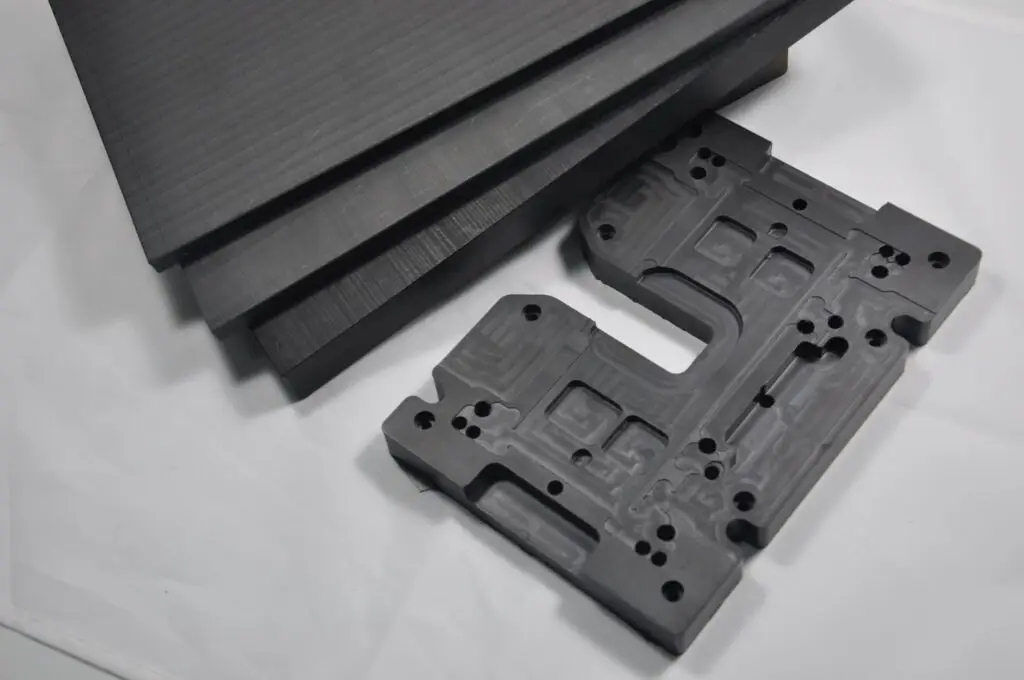
Socket designs change with every device generation, and tooling lead times do not suit that rhythm. Machining socket bodies, alignment plates, and handler fixtures from PEEK or PEI stock allows a functional socket in days, which is often faster than a mould can even be quoted. NAGOMER machines test-socket and burn-in hardware components to drawing with tight tolerances and full material traceability for semiconductor equipment customers.
Related reading: Engineering Plastics in Semiconductor Manufacturing Equipment, PEI (ULTEM) Plastic Sheet Guide, and PEEK Sheet Properties.

FAQ
Q1: What plastic is used for IC test sockets?
PEI is the standard for general test sockets, with PEEK used for higher-temperature burn-in and longer-life requirements. PPS serves cost-sensitive high-temperature designs.
Q2: Why does thermal expansion matter in sockets?
With hundreds of contacts, small differential expansion between socket and PCB causes pin misalignment and contact failures. Filled grades help match expansion.
Q3: Can sockets be machined instead of moulded?
Yes, and often they are for prototypes and low-volume device generations — machining from stock is much faster than tooling a mould.
Q4: How many insertions should a socket survive?
Requirements vary from thousands to hundreds of thousands depending on the device. Hard, filled polymers extend cavity life significantly.
Q5: Do socket materials need low outgassing?
In vacuum handlers and sealed burn-in environments, yes. PEEK and PEI both perform well under ASTM E595 criteria.
Developing test sockets or burn-in hardware? Contact NAGOMER for PEEK and PEI components machined to micron tolerances.
────────────────────────────────────────
NAGOMER — Professional Engineering Plastics Solutions
www.nagomer.com | info@nagomer.com