
News Centre
News Type
Send your inquiry

Plastics for Solar PV Manufacturing Equipment
Wet Chemical Stations
Process | Chemistry | Recommended material |
Texturing (mono) | Hot KOH / NaOH + additives | PVDF, PP, PFA |
Damage etch | HF + HNO3 mixtures | PFA, PTFE |
RCA clean / pre-diffusion | SC1, SC2, HF dips | PFA, PVDF, PTFE |
Post-etch rinse | Hot DI water | PVDF, PFA, PP |
Edge isolation | HF/HNO3 | PFA |
Tooling and cassettes | Various | PVDF, PEEK, PPS |
Alkaline texturing rules out several polymers that handle acids well, and HF rules out most of the rest. PFA and PTFE cover the widest range; PVDF is the workhorse for tanks, piping, and fittings where alkali and hot DI water dominate.
High-Temperature Process Steps
Diffusion furnaces, PECVD, and firing zones run far beyond the range of common plastics, so polymers there are confined to insulators, carriers, and handling hardware rather than hot-zone components. PEEK, PI, and PPS appear in wafer and cell carriers, end effectors, and insulating supports that must survive repeated excursions to 200°C and above without outgassing or deforming. Where a part enters a furnace tube, the limiting factor is usually outgassing and particle generation rather than strength.
Lamination and Backsheet Handling
· Lamination platens and handling pads: high-temperature silicone or PTFE-faced surfaces
· Rollers and guides: PEEK, POM, and PET-P for dimensional stability at 150–200°C
· Vacuum components: low-outgassing grades, avoid plasticised compounds
· Static control on film handling: dissipative grades to prevent dust attraction
· Edge trimming and conveying: UHMW-PE for low friction where temperature allows
Contamination Control
Cell efficiency is sensitive to metal contamination, especially iron, copper, and nickel, which create recombination centres. Polymer components in contact with wafers or cells should therefore be selected for low extractable ion content, not merely for chemical resistance. Pigments, fillers, mould release agents, and lubricants are the usual sources of trace metals, which is why unpigmented or specifically qualified grades are preferred in front-end positions. Natural-colour PVDF and PFA are common for that reason.
Specifying for a Line Build or Retrofit
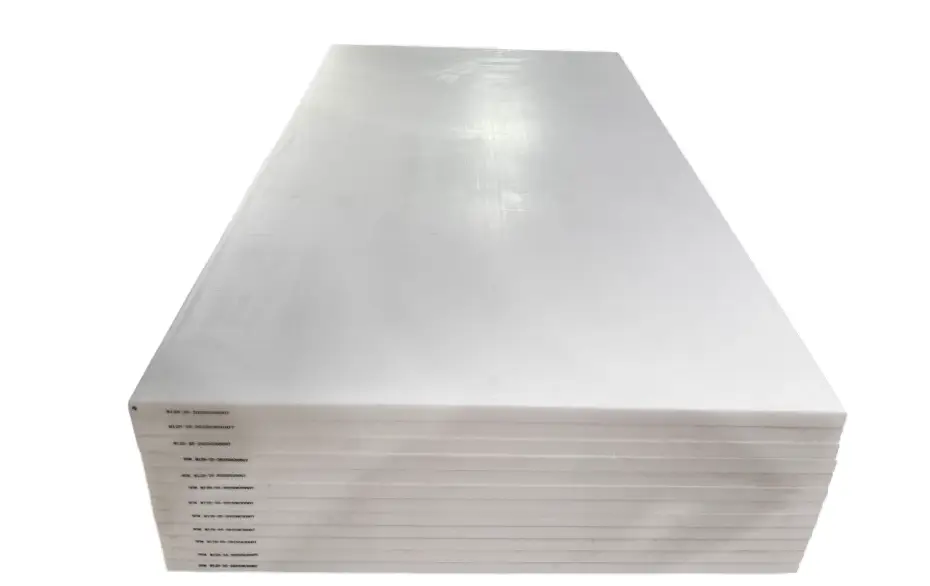
Equipment builders and line operators usually need both fabricated and machined components: welded PFA and PVDF tanks and ducting, machined rollers, carriers, and insulators. Stock shape availability determines lead time more often than price does, particularly for large PVDF plate and thick-wall PFA tubing. NAGOMER supplies PVDF, PFA, PTFE, PEEK, and PPS stock shapes for wet process equipment, cell handling, and lamination tooling, and machines components to drawing for line upgrades.
Related reading: PVDF Sheet and Rod Guide, PFA and FEP Fluoropolymer Guide, and Plastics for Semiconductor Wet Processing and Wafer Handling.

FAQ
Q1: What material handles hot KOH in texturing?
PVDF, PP, and PFA all resist hot alkaline solutions. PVDF is the most common for tanks and piping in texturing lines.
Q2: Which plastic resists HF in solar etch processes?
PFA and PTFE. PVDF has limited HF resistance, and most other polymers are unsuitable.
Q3: Why does metal contamination matter in PV manufacturing?
Iron, copper, and nickel create recombination centres in silicon, reducing cell efficiency. Low-extractable grades are preferred near the wafer.
Q4: Can plastics be used inside diffusion furnaces?
Only as carriers and insulators on the periphery. Hot-zone components are quartz and graphite; polymers serve handling and insulation roles.
Q5: What is used for lamination handling surfaces?
PTFE-faced or high-temperature silicone surfaces on platens, with PEEK or PET-P for structural rollers and guides.
Building or upgrading a PV line? NAGOMER supplies PVDF, PFA, PEEK and PTFE components to drawing.
────────────────────────────────────────
NAGOMER — Professional Engineering Plastics Solutions
www.nagomer.com | info@nagomer.com