
News Centre
News Type
Send your inquiry

Plastics for Textile Machinery: Wear, Friction and Heat Resistance
What Textile Machinery Demands
· Precisely controlled friction — enough to tension yarn, not enough to abrade it
· Wear resistance measured in millions of metres of yarn contact
· Heat resistance for texturising, heat-setting, and drying positions
· Static dissipation to prevent yarn ballooning and lap-ups
· Resistance to spin finishes, lubricating oils, and dye chemistry
· Surface finish that will not snag fine filaments
Material Selection by Position
Position | Material | Reason |
Yarn guides & thread guides | POM, PEEK, PET-P | Smooth surface, wear resistance, low friction |
Texturising & heat-set elements | PEEK, PPS | Continuous 200°C+ exposure |
Roller & bearing components | POM, PEEK composites | High speed, low maintenance |
Feed & traverse parts | PET-P, PA cast | Dimensionally stable, wear resistant |
Dyeing & finishing carriers | PP, PVDF, PEEK | Chemical resistance at temperature |
Draw-off & tension devices | POM, PEEK | Consistent friction over long runs |
Friction Is the Whole Design Problem
In textile machinery, friction is not simply a loss to be minimised — it is a process parameter. Yarn tension depends on it, and a guide that changes friction characteristics as it wears will change the product. That is why polymer guides replace metal in so many positions: they maintain a low, stable friction coefficient that does not polish upward with use, and they do not generate the microscopic burrs that abrade fine filaments. The choice between POM, PET-P, and PEEK then comes down to temperature and load, not to friction itself, since all three sit at similar levels.
Static and Finish Chemistry
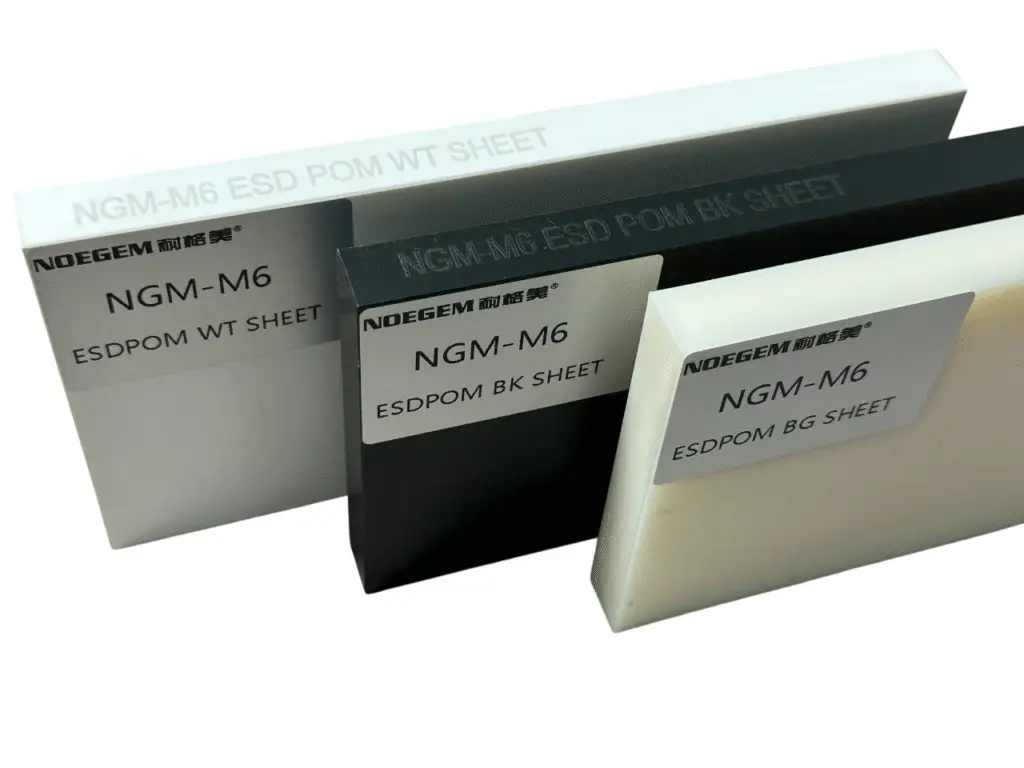
Two additional factors separate successful textile applications from troublesome ones. First, static: fast-moving yarn generates charge, and ESD-capable grades prevent the lap-ups and ballooning that stop production. Second, chemistry: spin finishes, oils, and dye carriers are designed to coat surfaces, and a polymer guide that swells or softens in contact with them will fail. Always check compatibility against the specific finish chemistry in use rather than against water alone, and prefer grades that have been proven in textile service. NAGOMER machines guides, rollers, and wear parts in POM, PET-P, PEEK, and ESD grades for textile machinery builders.
Cost of Ownership on a Spinning Line
Textile lines run continuously, and a stopped spindle is expensive. Polymer guides typically outlast metal components several times over in yarn contact duty, and they can be replaced without tools or specialist labour. The calculation is simple: a slightly more expensive guide that lasts three times as long and never scratches the yarn pays for itself in a single production cycle.
Related reading: PEEK Filled Grades Guide, PET-P Sheet & Rod Guide, and ESD Plastic Materials Guide.

FAQ
Q1: Which plastic is used for yarn guides?
POM, PET-P, and PEEK dominate, chosen for stable low friction, wear resistance, and the ability to hold a smooth surface that will not snag filaments.
Q2: Do textile guides need to be static dissipative?
Wherever yarn runs at speed, ESD-capable grades prevent charge build-up that causes ballooning, lap-ups, and quality defects.
Q3: Can plastics handle texturising temperatures?
PEEK and PPS serve continuously above 200°C, which is why they replace metal and standard engineering plastics in heat-set and texturising positions.
Q4: How long do polymer guides last?
Commonly several times longer than metal equivalents in yarn contact duty, with the additional advantage of not polishing into a cutting edge.
Q5: Are spin finishes a problem for plastics?
They can be. Oil- and solvent-based finishes affect some polymers, so compatibility should be verified against the actual finish chemistry used on the line.
Building or servicing textile machinery? Contact NAGOMER for guide, roller, and wear components in POM, PET-P, PEEK, and ESD grades.
────────────────────────────────────────
NAGOMER — Professional Engineering Plastics Solutions
www.nagomer.com | info@nagomer.com